Starting from a different premise
Correction-based feedback works in a narrow sense. But it has a fundamental problem: it neglects human psychology. Whenever drivers open the app they often start with a negative sentiment. Correction-based feedback, even when constructive, rarely changes behavior in a lasting way.
The Good Miles concept aims to change this. What if instead of counting the bad moments, we counted the good ones?
Existing design

New design


Every mile driven without a driving event counts as a Good Mile. Users see a counter that keeps growing as they drive. The hope is that this creates a motivating experience, and a less judgemental one.
What Duolingo got right
Duolingo was a meaningful reference point for this project. Their approach to gamification centers on a simple idea: every moment something is done well, take the opportunity to reward it. Streaks, XP, encouragement, all of it reinforces the same message: you did something right today.
That instinct directly shaped my design thinking for Good Miles. Duolingo proved that consistent positive reinforcement is more powerful than correction at building habits people stick to. For a driving app where the goal is genuine behavioral change over months, that matters enormously.

Good Miles: the currency of good driving
Drive without events
Every mile driven without a hard brake, rapid acceleration, or speeding incident registers as a Good Mile. The sensor works silently, no action required from the driver.

Avatar customization
Good Miles unlock skins, accessories, and visual upgrades for your car avatar. Customizations transfer directly to the in-car display: what you build in the app is what you see while you drive.

Real-world rewards
Good Miles redeem for tangible car services like oil changes, car washes, and maintenance discounts, creating a real-world incentive loop tied directly to good driving behavior.

Two experiences, intentionally different
In-car
For when the user is driving and wants a sense of how they're doing in real time, without being distracted by details.
Mobile app
For when the user is done driving and wants to dig into the details and engage with richer interactions.
In-car: your car as a virtual avatar

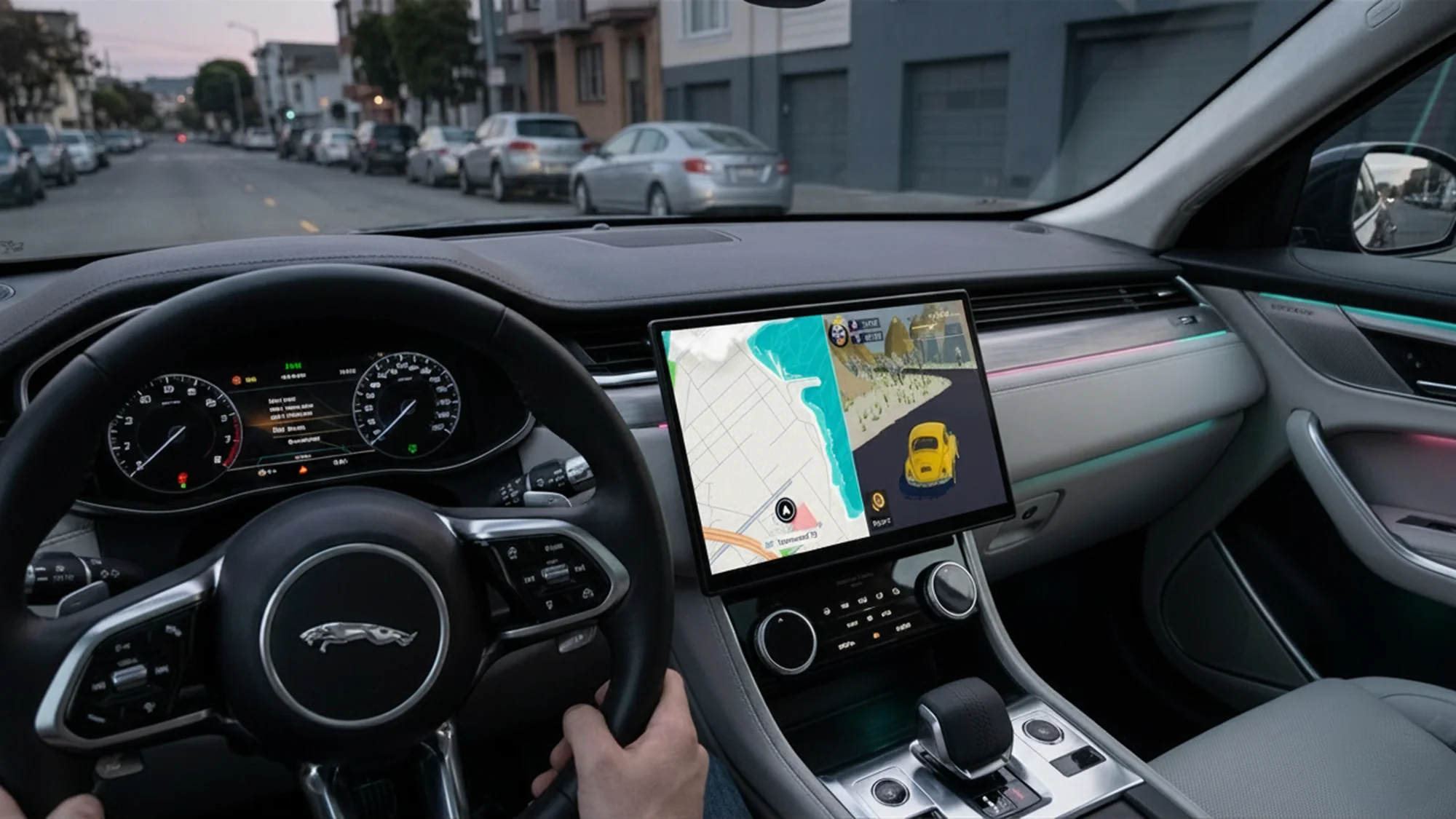
The visual centerpiece of the in-car experience is the car avatar, a third-person view of your customized vehicle, seen from behind, moving down the road as you drive. It's designed to feel like a Tamagotchi: a persistent character that's alive, responsive, and genuinely yours.
When you drive smoothly, the avatar chugs along contentedly. When a driving event is detected, it reacts with a visual animation that gives immediate, ambient feedback without demanding attention. When speeding is detected, a dynamic speedometer visualization appears. The avatar lives in peripheral vision, never asking to be stared at.

The third-person view creates a layer of externalized perspective: you're watching yourself drive. That slight psychological distance is what makes the avatar feel like a companion rather than an overlay. You're not just in the car. You're watching your car do well.
The mobile app: meaning-making after the drive
The app is where drivers reflect, improve, and invest. Opening it after a trip is the payoff: you see your route, the safe miles added, where events happened on the map, and specific coaching on how to prevent each one next time.

Avatar customization is a significant engagement driver. The avatar built in the app shows up in the in-car display, so every customization choice is something the driver sees on every future drive. This creates a loop: drive to earn miles, spend miles to upgrade the avatar, see the avatar change in-car, want to protect and improve it more.

Challenges and leaderboards also live exclusively here, by design. Signing up for a stretch goal requires attention and commitment, both of which belong off the road. Once a challenge is active, the in-car experience records the data silently. No friction, no decision-making, just driving.


Prioritizing carrot over stick
The gamification system was designed around a single discipline: every time a driver does something well, take the opportunity to acknowledge it. Not once per trip, not once per week. Every time. This is the instinct borrowed from Duolingo. Celebrate every small win to build consistency and lasting driving habits.
For Good Miles, reward moments are designed at multiple scales: the micro (a smooth braking sequence), the session (a clean trip), the streak (a consistent week), and the milestone (1,000 safe miles). Each scale has its own recognition mechanism.
Final wireframes
Bad weather

Real-time coaching (approaching school zone)

Reporting potholes

Nudge from mobile app

User journey


From wireframes to final UI
After I completed the wireframes and UX direction, I handed off to two other designers who brought the visual design to life.
In-car experience


Mobile experience


Well received, parked on purpose
The concept was pitched to organizational leadership and was well received. The team recognized the potential of a reward-based model to improve driver engagement and retention. However, the decision was made to hold off on pursuing it. At this stage, the priority was customer acquisition: getting enough users onto the platform first, before investing in engagement and retention mechanics.
It was the right call for where the business was. Good Miles addressed a real problem, but not the most urgent one. The concept remains on the roadmap as something to revisit once the user base reaches a scale where retention becomes the primary growth lever.